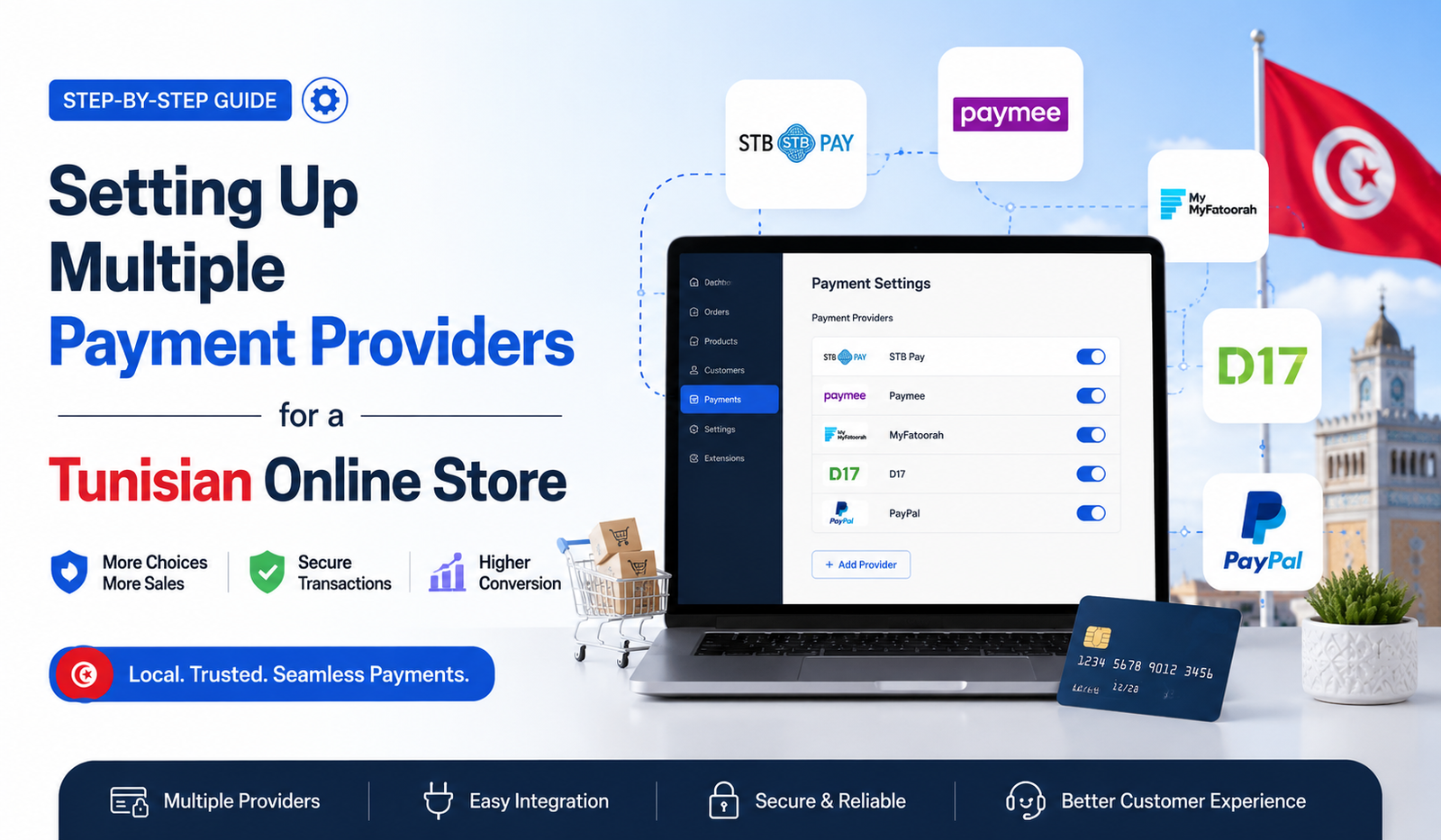
Setting Up Multiple Payment Providers for a Tunisian Online Store
Most Tunisian online stores cannot rely on a single payment provider. The global platforms that handle everything elsewhere are largely unavailable, and no single local provider covers every way Tunisians pay.
The practical answer is a multi-provider setup: several payment options working together on one store. This guide explains why that setup is the norm in Tunisia, what goes into it, and how to keep it manageable.
Table of Contents
- Why One Provider Is Not Enough in Tunisia
- The Building Blocks of a Tunisian Payment Setup
- What Running Several Providers Really Means
- More Than Coverage: The Reliability Benefit
- The Hidden Cost of Managing Providers Separately
- How One Integration Simplifies the Setup
- Building the Setup in the Right Order
- Signs Your Setup Is Working
- Common Mistakes to Avoid
- FAQs
1. Why One Provider Is Not Enough in Tunisia
Start with the constraint. Global gateways like Stripe and PayPal do not fully serve Tunisian-registered businesses, so the single-processor setup common elsewhere is off the table.
Currency controls are the reason. Overseen by the Banque Centrale de Tunisie, they keep the dinar from being freely convertible and limit the cross-border money movement those platforms depend on.
So Tunisian merchants build on local payment methods instead. The catch is that no single local provider covers cards, wallets, and cash on delivery all at once.
To reach every customer, a store needs more than one. That is why the multi-provider setup exists in Tunisia, not as a luxury, but as the default.
2. The Building Blocks of a Tunisian Payment Setup
A typical setup combines a few layers, each covering a different slice of buyers:
- Local card payments: processors such as ClicToPay, Paymee, or Konnect handle Tunisian bank cards in dinar.
- A mobile wallet: apps like Flouci and D17 reach buyers who prefer paying from a phone.
- Cash on delivery: still trusted by a large share of shoppers, especially first-time buyers.
- A cross-border route: used selectively, where currency rules and demand allow.
The exact mix depends on your customers and your average order value. A fashion store selling nationwide leans on cards and cash; a digital-goods seller may need a wallet and a cross-border option.
Think in terms of segments. Urban card users, phone-first wallet users, and cautious cash-on-delivery buyers are three different groups, and a strong setup has an answer for each.
Fees also differ across these options. Local card and wallet payments usually cost less than international card transactions, so the mix you choose affects margins as well as reach.
The goal is simple: whoever lands on your checkout should find a way to pay that feels normal to them. For a fuller view of the local payment methods for Tunisian stores, it helps to map each option to a customer type before you add it. Merchants adding a wallet to a Shopify store can follow a Flouci integration guide for Shopify to connect one of the most widely used options.
3. What Running Several Providers Really Means
Running several providers does not mean bolting on every option you can find. It means choosing a deliberate set that covers your buyers without redundancy.
On Shopify and similar platforms, each provider is usually added as its own payment method at checkout. The buyer picks one; the transaction lands in that provider’s system.
Two or three well-chosen providers usually cover the vast majority of Tunisian buyers. Adding a tenth option rarely helps and only adds complexity.
The skill is in the selection, not the quantity. Match providers to how your specific customers pay, then stop.
4. More Than Coverage: The Reliability Benefit
Multiple providers do more than widen payment choice. They protect your store when something goes wrong.
If one provider has downtime or declines a valid card, another can still complete the sale. A single-provider store has no such fallback, and an outage means lost orders.
In a market where local providers vary in uptime and support, that redundancy is worth having. It turns a fragile checkout into a resilient one.
The benefit grows with volume. The more sales you process, the more a single failed provider would cost you, and the more a fallback is worth.
5. The Hidden Cost of Managing Providers Separately
Running several providers has a downside that shows up after setup, not during it:
- Separate dashboards: each provider has its own login, reports, and payout schedule.
- Separate reconciliation: matching orders to payouts across providers by hand eats time and invites errors.
- Separate support: when something breaks, you deal with each provider on its own.
- Fragmented data: you never see total sales in one place, which makes decisions harder.
For a small team, this overhead is real. Many Tunisian merchants find the setup easy to launch but tiring to run month after month.
This is the problem that shapes the next step: how to keep the benefits of multiple providers without the management burden.
6. How One Integration Simplifies the Setup
The way around the overhead is to connect providers through a single layer rather than one by one.
A payment mediation platform sits between your store and several providers. You integrate once, and the platform routes each transaction to the right provider behind the scenes.
Reporting and reconciliation then come together in one view. You still offer many ways to pay, but you manage one connection instead of many.
Unified reporting also means cleaner books. Instead of stitching together payouts from several sources, you see every transaction, fee, and settlement in one place.
Platforms such as UnumPay take this approach for Shopify stores, linking local and international providers through a single integration. For merchants weighing their Tunisia ecommerce payment options, this is what makes a multi-provider setup sustainable rather than a chore. It also helps to see the Shopify payment options for Tunisia that can be brought into one checkout this way.
7. Building the Setup in the Right Order
A setup is easier to run if you build it in a sensible sequence:
- Start with local cards: they cover the widest base of paying customers.
- Add cash on delivery: it captures cautious and first-time buyers.
- Layer in a wallet: to reach mobile-first shoppers.
- Add cross-border last: only if you actually sell abroad and the rules allow.
Building in this order means your store can take payments early, then expand coverage without disrupting what already works.
It also keeps costs in check, since you add each provider when there is a clear reason. For stores focused on checkout options for Tunisian buyers, local-first is almost always the right starting point. It is also worth checking how a single-integration approach is priced for merchants before committing to a mix.
8. Signs Your Setup Is Working
You do not need complex analytics to judge a payment setup. A few signals tell you most of what matters:
- High checkout completion: most buyers who reach checkout finish paying.
- Few missing-option drop-offs: buyers are not leaving because their method is absent.
- Clean reconciliation: payouts match orders without manual guesswork.
- Balanced usage: each provider carries a meaningful share, confirming it earns its place.
If one provider handles almost nothing, drop it. If buyers still abandon at payment, a method is missing. The setup should evolve with what the numbers show.
9. Common Mistakes to Avoid
A few missteps show up again and again:
- Too many providers: more options can confuse buyers and multiply your admin.
- Ignoring reconciliation: if you cannot match payouts to orders, your books drift.
- Forgetting the dinar: buyers expect prices and payment in their own currency.
- Copying a foreign playbook: setups built for the US or Europe assume gateways Tunisia does not have.
Each mistake traces back to the same root: treating a Tunisian store like a store anywhere else. The market has its own rules, and the setup has to respect them.
FAQs
Why do Tunisian stores need more than one payment provider? Because no single provider covers cards, wallets, and cash on delivery, and global gateways are largely unavailable.
How many providers should a Tunisian store use? Usually two or three, chosen to cover your main customer types without adding needless complexity.
Can I still accept international cards? Sometimes, through a selective cross-border route, though currency controls limit how far this goes.
What makes managing several providers hard? Separate dashboards, reconciliation, and support, which add up to real overhead for small teams.
How does a mediation platform help? It connects several providers through one integration and brings reporting together in a single view.
The Bottom Line
In Tunisia, running several payment providers on one store is not a workaround. It is the standard way to sell online in a market where no single provider does everything.
The winning setup is deliberate, not crowded: local cards, a wallet, cash on delivery, and a cross-border route only where it earns its place.
Manage that mix through one connection, and you get the reach of many providers with the effort of one. That is what a well-built Tunisian payment setup looks like.