Cracking the Code: 5 Mathematical Methods Strategies for Top ATAR Scores
For Year 12 students in Australia, Mathematical Methods is often viewed as the “gatekeeper” subject. It is the prerequisite for high-tier engineering, medicine, and data science degrees, and due to its difficulty, it carries a significant scaling advantage. However, achieving a raw score of 40+ (leading to a high 90s ATAR contribution) requires more than just being “good at sums.”
It requires a high-level strategic approach to the VCAA, QCAA, or SACE curriculum. To excel, you must move beyond rote learning and master the art of mathematical application. Here are five data-driven strategies to help you dominate your Methods exams and secure that elite ATAR.
1. Master the “Analysis Task” Hierarchy
In the final external examinations, the difference between a 35 and a 45 raw score lies in the “Analysis” section. Data from previous Victorian Training and Assessment Authority (VCAA) examiner reports consistently shows that while most students can solve “Skill” questions (differentiation, basic integration), they struggle with multi-part questions that link functions, calculus, and probability.
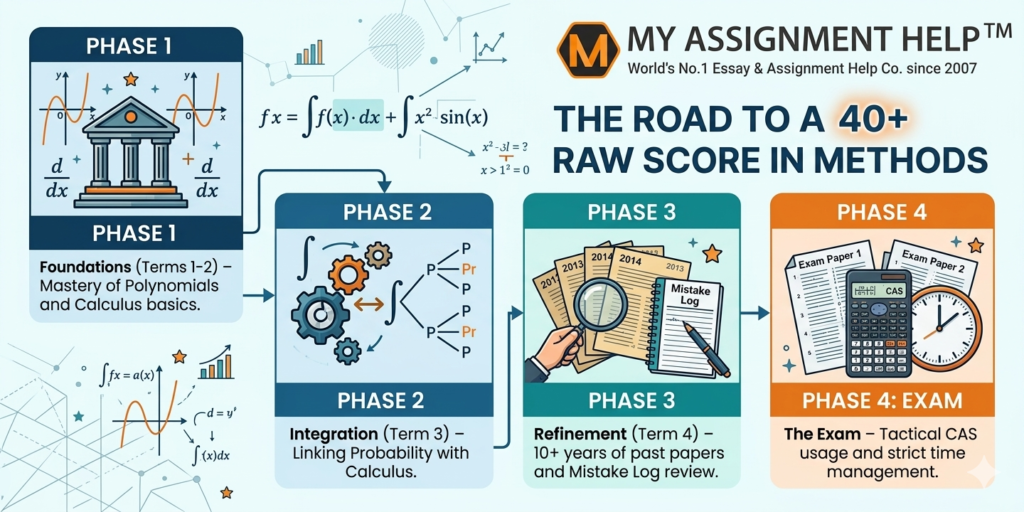
To combat this, use the Layered Learning Approach. Don’t just practice isolated chapters. Take a trigonometric function, find its derivative, calculate the area under its curve using definite integrals, and then apply a probability density function context to it. This mimics the interconnected nature of the Section B exam papers.
2. Optimize Your CAS Efficiency
Your Computer Algebra System (CAS) is your greatest ally, but it can also be a time-sink. Top-tier students don’t just use the CAS to solve equations; they use it to verify logical steps.
A common pitfall is “CAS-heavy” working where students lose marks because they fail to show the mathematical “setup” before jumping to the answer. To maintain high-level accuracy, use your CAS for:
- Solving complex simultaneous equations.
- Checking the validity of endpoints in restricted domains.
- Quickly sketching functions to identify asymptotes or intercepts.
If you find yourself overwhelmed by the technical load of your coursework, seeking professional Math Assignment Help can provide the clarity needed to bridge the gap between manual calculations and CAS proficiency.
3. The 80/20 Rule of Probability and Statistics
The “Statistics and Probability” module often accounts for roughly 20-25% of the total marks in Methods, yet it is frequently the area where students lose the most marks due to conceptual misunderstandings of “Discrete vs. Continuous” variables and “Normal Distribution.”
The strategy here is to build a Summary Sheet specifically for probability notation. According to educational data, students who categorize their errors—identifying if they missed a mark due to a calculation error or a conceptual misunderstanding—see a 15% improvement in mock exam scores.
If the pressure of maintaining these summaries alongside other subjects is too high, you might consider reaching out to experts to do my assignment so you can focus your energy on high-stakes exam revision.
4. Reverse-Engineer the Examiner Reports
One of the most underutilized resources is the annual Examiner’s Report. These documents provide a goldmine of data on where the cohort failed. For example, reports often highlight that students lose marks for:
- Forgetting the $+c$ in indefinite integrals.
- Using degrees instead of radians (a fatal error in Methods).
- Failing to give “exact values” when specified.
Strategy: Create a “Mistake Log.” Every time you get a SAC (School Assessed Coursework) or practice exam question wrong, document the reason. By the time the final exam arrives, you will have a personalized checklist of “traps” to avoid.
5. Temporal Management and the “Scan-Skip-Solve” Method
The ATAR is as much a test of endurance as it is of intelligence. Exam 1 (Technology-Free) is a 60-minute sprint, while Exam 2 (Technology-Active) is a marathon.
To maximize marks:
- Scan (2 mins): Identify the “easy wins”—basic differentiation or probability.
- Skip (During the process): If a question takes more than 3 minutes without a clear path to the solution, move on.
- Solve (Remaining time): Return to the difficult multi-part questions once the “safety” marks are banked.
Key Takeaways for Students
- Interlink Concepts: Never study calculus in isolation from functions.
- Show Your Working: Even in CAS-active exams, the “method” earns the marks.
- Stay in Radians: Unless explicitly stated otherwise, the Methods world lives in radians.
- Use Data: Analyze your own performance trends to identify weak spots in the curriculum.
Frequently Asked Questions (FAQ)
Q: How many practice exams should I do for Mathematical Methods?
A: Quality beats quantity. Aim for 10-15 timed exams, but ensure you spend double the time reviewing the solutions and Examiner Reports for each.
Q: Is it better to focus on Exam 1 or Exam 2?
A: While Exam 2 is worth more in terms of raw marks, Exam 1 tests your fundamental understanding. You cannot succeed in Exam 2 if your algebraic manipulation (tested in Exam 1) is weak.
Q: Can I get a high ATAR if I find Methods difficult?
A: Yes. Because Methods scales significantly, even a mid-range raw score can result in a high scaled score. Consistency is more important than perfection.
About the Author
Senior Academic Consultant, MyAssignmentHelp
The author is a seasoned content strategist and academic mentor with over 10 years of experience in the Australian education sector. Specializing in STEM curriculum development and senior secondary success strategies, they have helped thousands of students navigate the complexities of VCE, HSC, and QCE assessments. Currently contributing to the research team at MyAssignmentHelp, they focus on creating data-driven resources that simplify complex mathematical concepts for graduating students.
References
- VCAA (2023) Mathematical Methods Examination 2 Report.
- Department of Education, Australia: Senior Secondary Curriculum Standards.
- Hattie, J. (2023). Visible Learning for Mathematics: Maximizing Student Motivation and Achievement.
- The University of Melbourne: Quantitative Research on ATAR Scaling and Subject Selection.